The South Wales Miners by Ben Curtis
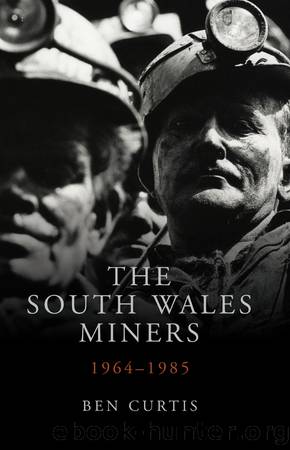
Author:Ben Curtis [Curtis, Ben]
Language: eng
Format: epub
Tags: History, Europe, Great Britain, General
ISBN: 9780708326114
Google: Tmp4swEACAAJ
Publisher: University of Wales Press
Published: 2013-01-15T03:33:42+00:00
THE INCENTIVE BONUS SCHEME
All of the main problems facing the south Wales miners in the later 1970s â stagnant output levels, the wages struggle, and the âmoderateâ dominance of the NEC â were brought to a head by a single issue, the introduction of the incentive bonus scheme. Alongside the strikes of 1972 and 1974, this was the most important development in the history of the NUM in that decade. The scheme represented the antithesis of the factors which had brought about the minersâ victories of the early 1970s. As such, it played a crucial role in undermining NUM unity, which was to prove decisive in 1984. Consequently, the incentive bonus scheme has been a focus of historiographical attention. For Ashworth, it was an ambiguous development that boosted minersâ average earnings but lessened inter-Area solidarity. Francis and Smith observe that the problem of improving basic wages was aggravated by the scheme because it weakened the NPLA. For Allen, the episode showed that the NUM Right was happy to ignore its much-vaunted âconstitutionalismâ in order to push through the incentive system.65
The introduction of the NPLA in 1966 had been one of the biggest gains made by the NUM in the post-war period and represented the realisation of a long-held objective. Establishment of a daywage system across the whole industry had had several far-reaching repercussions, for example, the dramatically reduced incidence of localised strikes which had previously characterised coal-mining industrial relations. In 1956, the industry accounted for 78.4 per cent of all strikes in Britain; by 1970, this figure was only 4.1 per cent.66 Payment of the same wage for the same work was seen by the south Wales miners to embody an important principle. Furthermore, a universal daywage system shifted the onus for production away from the workers, since they were now paid a guaranteed rate. Consequently, productivity levels began to stagnate from around 1974, as the management proved unable to increase output. The NCBâs proposed solution was a system whereby miners would earn more if they produced more â in other words, a return to piecework.
Hostility to the bonus scheme was particularly widespread in south Wales, partly because of safety factors, partly because of difficult geological conditions and partly because it created competition and tension in the workplace as miners strove to maximise their own output; it was the antithesis of co-operative trade union principles. As Emlyn Williams commented in 1978: âItâs the law of the jungle and we havenât even got spearsâ.67
As a result of these concerns, in the mid-1970s the Area discussed several solutions which addressed the output question without forcing miners into competition with one another. Following the first ballot defeat of the incentive bonus scheme in late 1974, the NUM adopted Dai Francisâs plan for a national-level productivity system. Under this plan, output bonuses would be tied to a national target, without individual collieries being labelled as either âsuccessesâ or âfailuresâ. The NCB seemed prepared initially to consider this option, before events swung back in its favour.
Download
This site does not store any files on its server. We only index and link to content provided by other sites. Please contact the content providers to delete copyright contents if any and email us, we'll remove relevant links or contents immediately.
| Africa | Americas |
| Arctic & Antarctica | Asia |
| Australia & Oceania | Europe |
| Middle East | Russia |
| United States | World |
| Ancient Civilizations | Military |
| Historical Study & Educational Resources |
Room 212 by Kate Stewart(5180)
The Crown by Robert Lacey(4861)
Endurance: Shackleton's Incredible Voyage by Alfred Lansing(4842)
The Iron Duke by The Iron Duke(4404)
The Rape of Nanking by Iris Chang(4255)
Joan of Arc by Mary Gordon(4155)
Say Nothing by Patrick Radden Keefe(4042)
Killing England by Bill O'Reilly(4041)
I'll Give You the Sun by Jandy Nelson(3496)
Shadow of Night by Deborah Harkness(3407)
Hitler's Monsters by Eric Kurlander(3382)
Mary, Queen of Scots, and the Murder of Lord Darnley by Alison Weir(3240)
Blood and Sand by Alex Von Tunzelmann(3237)
Eleanor & Park by Rainbow Rowell(3232)
Darkest Hour by Anthony McCarten(3161)
Margaret Thatcher: The Autobiography by Thatcher Margaret(3113)
Book of Life by Deborah Harkness(2982)
Red Famine: Stalin's War on Ukraine by Anne Applebaum(2968)
The One Memory of Flora Banks by Emily Barr(2895)
